M2 Internship: Visualising Uncertainty Propagation in Probabilistic Models
Application to Sustainable Material Design
Keywords: Information Visualisation, Human–Computer Interaction, uncertainty visualisation, visual analytics, probabilistic graphical models, Human-Centred AI
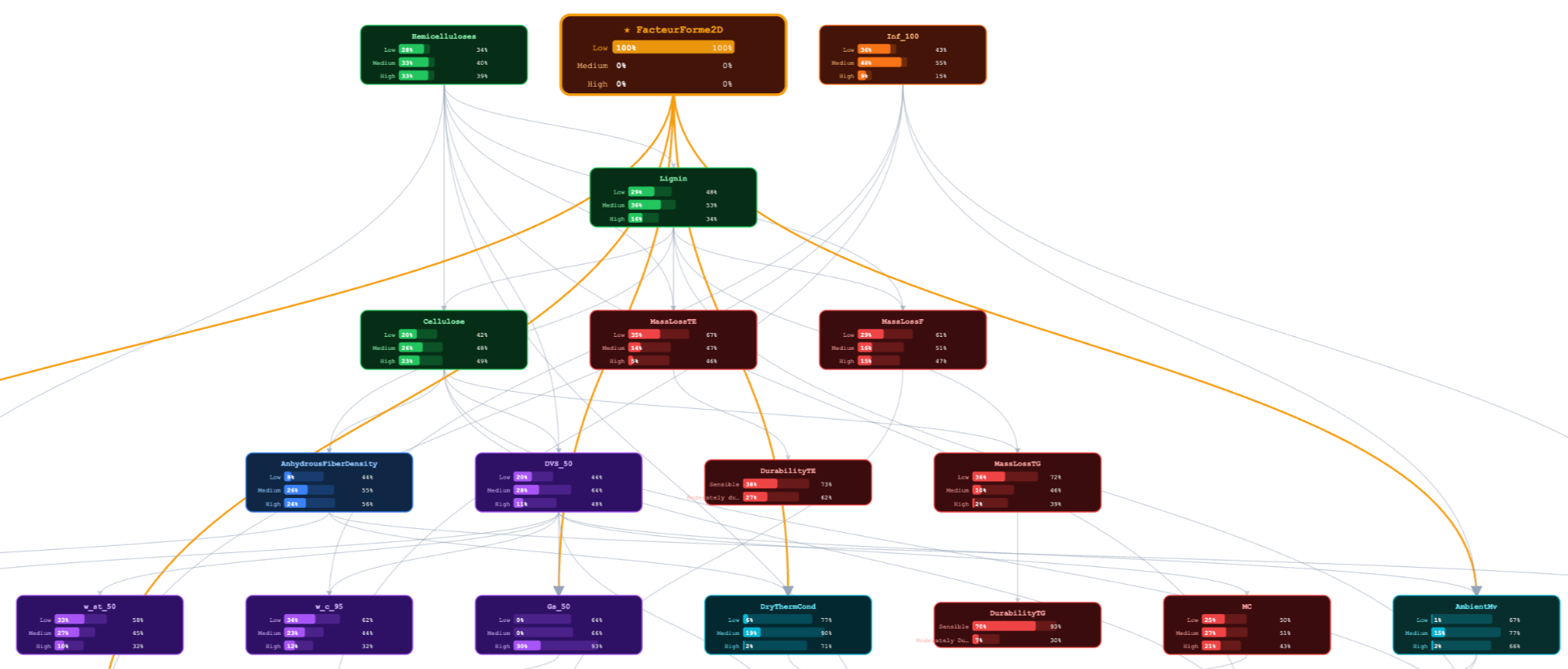
Figure 1. Early prototype of a credal network visualization. Nodes show uncertainty bounds (low, medium, and high), with colors representing material properties. Orange arrows highlight relationships affected by evidence provided by an expert. As multiple changes occur simultaneously across the network, it becomes difficult to identify where uncertainty changes, trace the effects of evidence, and interpret the nature of these changes.
Context and research problem
Scientists increasingly rely on probabilistic models to reason about complex systems under uncertainty. Interactive visualisation can help users explore such models and understand the consequences of introducing new evidence. Previous work has proposed visualization techniques for comparing the effects of different evidence configurations in Bayesian networks, while recent user-centred research has demonstrated the value of interactive evidence propagation for helping domain experts explore and validate probabilistic models (Johnson, 2025).
These approaches primarily consider models in which probabilities are precisely specified. In many scientific applications, however, available knowledge is itself incomplete or imprecise. Credal networks address this problem by extending Bayesian networks to represent sets of plausible probabilities, often summarised by lower and upper probability bounds (Mauá, 2020). Exact and approximate inference algorithms exist (Cabanas, 2021; Huber, 2020) but their outputs introduce new challenges for human interpretation.
For example, after introducing evidence, a probability interval may shift, narrow or widen. Across a network, these effects may occur simultaneously for multiple interconnected variables. Users therefore need to understand not only how predictions have changed, but also where imprecision has increased or decreased and how these changes are distributed across the model.
Research in uncertainty visualisation has shown that the way epistemic uncertainty is represented can influence how people interpret information and make decisions (Sarma, 2025). In credal networks, an additional challenge is to represent lower and upper probabilities and communicate how these values change when evidence is introduced and propagated through the network. There is no universally best method among expected utility, maximality, E-admissibility, interval dominance, Γ-maximin, Γ-maximax, etc., as this depends on the decision context and users tolerance for uncertainty (Troffaes 2007).
The internship addresses the following research question: How can interactive visual representations support users in understanding the effects of evidence propagation on imprecise uncertainty in probabilistic graphical models?
Objectives
The goal of the internship is to design and empirically evaluate interactive visualisations for exploring uncertainty propagation in probabilistic models. The aim is to help the user to identify the variables for which the evidence provides the most information. The internship will be organised around four main stages:
- Review and task analysis: Review relevant work on uncertainty visualisation, visual comparison and probabilistic graphical models, and identify key user tasks for understanding how imprecise probabilities change following evidence propagation.
- Visualisation design: Explore a design space of visual representations for probability bounds and their changes, and select a small number of promising approaches for further development.
- Implementation: Build a generic visualization tool (web interface) to:
- integrate the selected designs into any given credal network (structure and parameters), as per Figure 1, enabling users to input evidence and analyse its impact across the network, irrespective of its configuration.
- couple the system with a large language model (LLM) to explain the inference results from the credal network within the field of study, ensuring that the reasoning aligns with domain-specific knowledge.
- Evaluation: Design and conduct an empirical user study comparing the selected representations, and analyse how they support users in identifying, comparing and interpreting changes in uncertainty.
The emphasis on (3) or (4) will depend on the selected student’s background.
Application: Sustainable Material Design
The research will be grounded in real-world models from the VISAGE (Visualization for Generative and Explainable AI in Sustainable Design) project at INRAE (France’s National Research Institute for Agriculture, Food and Environment). One application concerns insulating fibreboards manufactured from wood residues in French Guiana. Raw-material properties and manufacturing conditions influence characteristics such as thermal performance and durability, but experimental data are limited and some relationships remain uncertain. Credal networks make it possible to represent this incomplete knowledge without requiring every probability to be specified precisely.
A domain expert could, for example, introduce information about a material characteristic and explore how this evidence affects predictions and imprecision elsewhere in the model. This application provides a concrete scientific context for the research, while the visualisation questions and findings are intended to generalise beyond sustainable material design.
Expected outcomes
The internship is expected to produce a characterisation of relevant visualisation tasks and design alternatives, an interactive research prototype, an empirical comparison of selected visual representations, and design recommendations for communicating changing imprecise probabilities in probabilistic graphical models.
Depending on the results, the work may contribute to a scientific publication in Information Visualisation or Human–Computer Interaction. It may also open opportunities for further research on visual explanations of uncertainty propagation, uncertainty provenance, and human reasoning with uncertain AI models.
Candidate profile
We are looking for a motivated M2 student with a strong interest in Information Visualisation and/or Human-Computer Interaction. The candidate should be comfortable with programming and interested in designing, implementing and empirically evaluating interactive visualisations.
Experience with interactive visualisation, empirical user studies, or data analysis would be an advantage. An interest in uncertainty visualisation, Human-Centred AI or scientific applications is welcome.
Previous knowledge of Bayesian or credal networks is not required. The necessary concepts will be introduced during the internship, and probabilistic models and inference tools will be provided.
Available resources and environment
The student will have access to an existing interactive Bayesian-network visualisation, an early credal-network visualisation platform, inference tools and models, real-world VISAGE application cases, researchers specialising in probabilistic models, and domain experts.
Supervision: Nadia Boukhelifa, MIA Paris-Saclay, INRAE, in collaboration with researchers from the VISAGE project
Location: AgroParisTech Saclay Campus, Palaiseau, France
Duration: 4–6 months; beginning in or around January 2027
Allowance: approximately €650/month
How to apply
Send an e-mail with a motivation letter, CV, and marks & transcripts to Nadia Boukhelifa (nadia.boukhelifa@inrae.fr).
Selected references
Cabanas, R., & Antonucci, A. (2021, August). Crepo: An open repository to benchmark credal network algorithms. In International Symposium on Imprecise Probability: Theories and Applications (pp. 352-356). PMLR.
Champion, C., & Elkan, C. (2017). Visualizing the consequences of evidence in bayesian networks. arXiv preprint arXiv:1707.00791.
Huber, D., Cabañas, R., Antonucci, A., & Zaffalon, M. (2020, February). CREMA: a Java library for credal network inference. In International Conference on Probabilistic Graphical Models (pp. 613-616). PMLR.
Johnson, O. H., Munch, M., Kansou, K., Baudrit, C., Bezerianos, A., & Boukhelifa, N. (2025, April). Bridging Modeling and Domain Expertise Through Visualization: A Case Study on Bread-Making with Bayesian Networks. In Proceedings of the Extended Abstracts of the CHI Conference on Human Factors in Computing Systems.
Mauá, D. D., & Cozman, F. G. (2020). Thirty years of credal networks: Specification, algorithms and complexity. International Journal of Approximate Reasoning.
Sarma, A., Hedayati, M., & Kay, M. (2025, April). More forecasts, more (decision) problems: How uncertainty representations for multiple forecasts impact decision making. In Proceedings of the 2025 CHI Conference on Human Factors in Computing Systems.
Troffaes MC (2007) Decision making under uncertainty using imprecise probabilities. Int. J. Approx. Reason. 45(1), 17-29.