M2 Internship: Interactive Visualisation for Understanding and Comparing Environmental Impacts
Application to Life Cycle Assessment and Sustainable Food Design
Keywords: Information Visualisation, Human–Computer Interaction, visual analytics, Life Cycle Assessment, scenario comparison, environmental decision-making
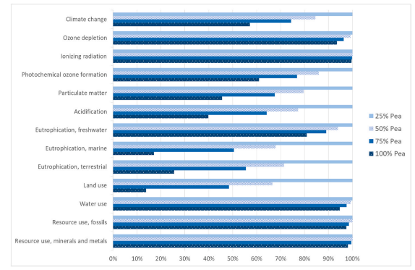
Figure 1. Environmental impacts across four food-production scenarios shown as a grouped bar chart, with colour shades encoding different animal/plant protein ratios. While differences between scenarios are visible, the underlying processes and flows driving them are not immediately apparent. Image taken from [3].
Context and research problem
Life Cycle Assessment (LCA) is a standardised methodology for evaluating the environmental impacts of products and production systems throughout their life cycle. It is increasingly used to compare alternatives and support ecodesign and innovation. However, LCA models can involve many processes, material and energy flows, and environmental indicators, making their results difficult to interpret, particularly for domain experts who are not LCA specialists [6].
This is especially challenging when comparing alternative scenarios. Conventional visualisations can show that two scenarios differ across environmental indicators, but understanding what drives these differences requires relating the observed impacts back to the underlying processes and flows. Users may need to determine which flows contribute most strongly to a difference, whether the same contributors are important across several environmental indicators, and how contributions change from one scenario to another.
Interactive visualisation offers opportunities to support this reasoning by connecting high-level comparisons to the underlying structure of an LCA model. Users could, for example, move from an observed difference between two scenarios to the processes and flows responsible for it, compare their relative contributions, and progressively explore more detailed levels of the assessment. Previous research has highlighted challenges in the visual presentation and interpretation of LCA results [6], while research in Information Visualisation has explored interactive approaches for supporting multi-criteria comparison and trade-off analysis [1,2].
The internship addresses the following research question: How can interactive visualisation support users in understanding what drives differences between alternative scenarios in Life Cycle Assessment?
Objectives
The goal of the internship is to design and empirically evaluate interactive visualisations for understanding differences between LCA scenarios. The internship will be organised around four main stages:
- Review and task analysis: Review relevant work on LCA visualisation, visual comparison and visual analytics, and identify key user tasks through the literature and discussions with LCA practitioners and domain experts. These may include identifying important contributors, comparing contributions between scenarios, and tracing observed differences to underlying processes and flows.
- Visualisation design: Explore a design space of visual representations and interactions for connecting environmental impacts to their underlying contributors, and select a small number of promising approaches for further development.
- Implementation: Develop an interactive research prototype allowing users to compare alternative LCA scenarios and explore the processes and flows contributing to observed environmental impacts.
- Evaluation: Design and conduct an empirical user study evaluating the selected approaches, and analyse how they support users in identifying, comparing and interpreting the factors driving differences between scenarios.
Application: Sustainable Food Design
The research will be conducted within the AVEC project at INRAE, which investigates methods for improving the understanding and interpretation of Life Cycle Assessment results. The internship focuses on two complementary challenges: understanding the contributions of individual flows to environmental impacts and comparing alternative scenarios. The application considers four fermented food products combining animal and plant proteins in different proportions [3]. Using existing LCA models and data, the student will investigate interactive visualisations that connect differences across environmental indicators to their underlying contributors (e.g., ingredients, processes, energy inputs and other flows), supporting exploration from scenario-level comparisons to more detailed explanations.
Expected outcomes
The internship is expected to produce a characterisation of relevant visualisation tasks and design alternatives, an interactive research prototype, an empirical evaluation of selected visual representations, and design recommendations for supporting explanation and comparison of LCA scenarios.
Depending on the results, the work may contribute to a scientific publication in Information Visualisation or Human-Computer Interaction. It may also open opportunities for further research on visual comparison, uncertainty communication, and interactive visual analysis of environmental models.
Candidate profile
We are looking for a motivated M2 student with a strong interest in Information Visualisation and/or Human-Computer Interaction. The candidate should be comfortable with programming and interested in designing, implementing and empirically evaluating interactive visualisations.
Experience with interactive visualisation, empirical user studies or data analysis would be an advantage. An interest in sustainability, environmental modelling or scientific applications is welcome.
Previous knowledge of Life Cycle Assessment is not required. The necessary concepts will be introduced during the internship, and LCA models, datasets and calculation tools will be provided.
Available resources and environment
The student will have access to existing Life Cycle Assessment (LCA) models, datasets, and calculations, as well as real-world AVEC application cases. They will also benefit from the guidance and expertise of researchers specialising in LCA and relevant domain experts. The work will also benefit from interactions with the MEANS platform at INRAE, which develops tools for multicriteria sustainability assessment. A preliminary prototype has been developed using a publicly available dataset, accessible here (registration required).
Supervision: Nadia Boukhelifa, MIA Paris-Saclay, INRAE, in collaboration with researchers from the AVEC project
Location: AgroParisTech Saclay Campus, Palaiseau, France
Duration: 4–6 months; beginning in or around January 2027
Allowance: approximately €650/month
How to apply
Send an e-mail with a motivation letter, CV, and marks & transcripts to Nadia Boukhelifa (nadia.boukhelifa@inrae.fr).
Selected references
[1] Chakhchoukh, M., Bezerianos, A., & Boukhelifa, N. (2026). Seeing the trade-offs: Evaluating visualizations for multi-criteria comparison of set alternatives. Information Visualization, 25(4), 495-517.
[2] Chakhchoukh, M., Boukhelifa, N., & Bezerianos, A. (2022). Understanding how in-visualization provenance can support trade-off analysis. IEEE Transactions on Visualization and Computer Graphics, 29(9), 3758-3774.
[3] Huguet, J., Chassard, C., Lavigne, R., Irlinger, F., Souchon, I., Marette, S., Saint-Eve, A., & Pénicaud, C. (2023). Environmental performance of mixed animal and plant protein sources for designing new fermented foods. Cleaner Environmental Systems, 9, 100115.
[4] De Luca, A. I., Iofrida, N., Leskinen, P., Stillitano, T., Falcone, G., Strano, A., & Gulisano, G. (2017). Life cycle tools combined with multi-criteria and participatory methods for agricultural sustainability: Insights from a systematic and critical review. Science of the Total Environment, 595, 352-370.
[5] Perrin, A., Yannou-Le Bris, G., Angevin, F., & Pénicaud, C. (2023). Sustainability assessment in innovation design processes: place, role, and conditions of use in agrifood systems. A review: Sustainability assessment in innovation design processes: place, role, and conditions of use in agrifood systems. A review. Agronomy for Sustainable Development, 43(1), 10.
[6] Rio, M., Blondin, F., & Zwolinski, P. (2019). Investigating product designer LCA preferred logics and visualisations. Procedia CIRP, 84, 191-196.